By Shana Thornton
The rivers define Clarksville and Montgomery County; they have carved out the land and where we will build and populate this region. The rivers have offered us modes of transportation; spaces for adventure, exploration, and entertainment; reverence for nature; awe at the power of water after powerful floods; nourishment in the forms of water and food sources; and sanctuaries for seeking a flow to life. We emulate rivers, and we try to shape them and change them to fit our needs. Rivers do not lack the ability to inspire and motivate us, as if they are living entities themselves. To the Shawnee, the Warioto, as they called the river, was a living being.
According to the Montgomery County Archives: “The Cumberland River is one of the major waterways of the Southeastern United States. The source of the river is in the Appalachian Mountains, and it travels 688 miles through southern Kentucky and northern Tennessee. The river flows to the Ohio River in Paducah, Kentucky, and its main tributaries are the Obey, Stones, and Red Rivers. The river was home to the Shawnee Native Americans who originally called it the Warioto.”
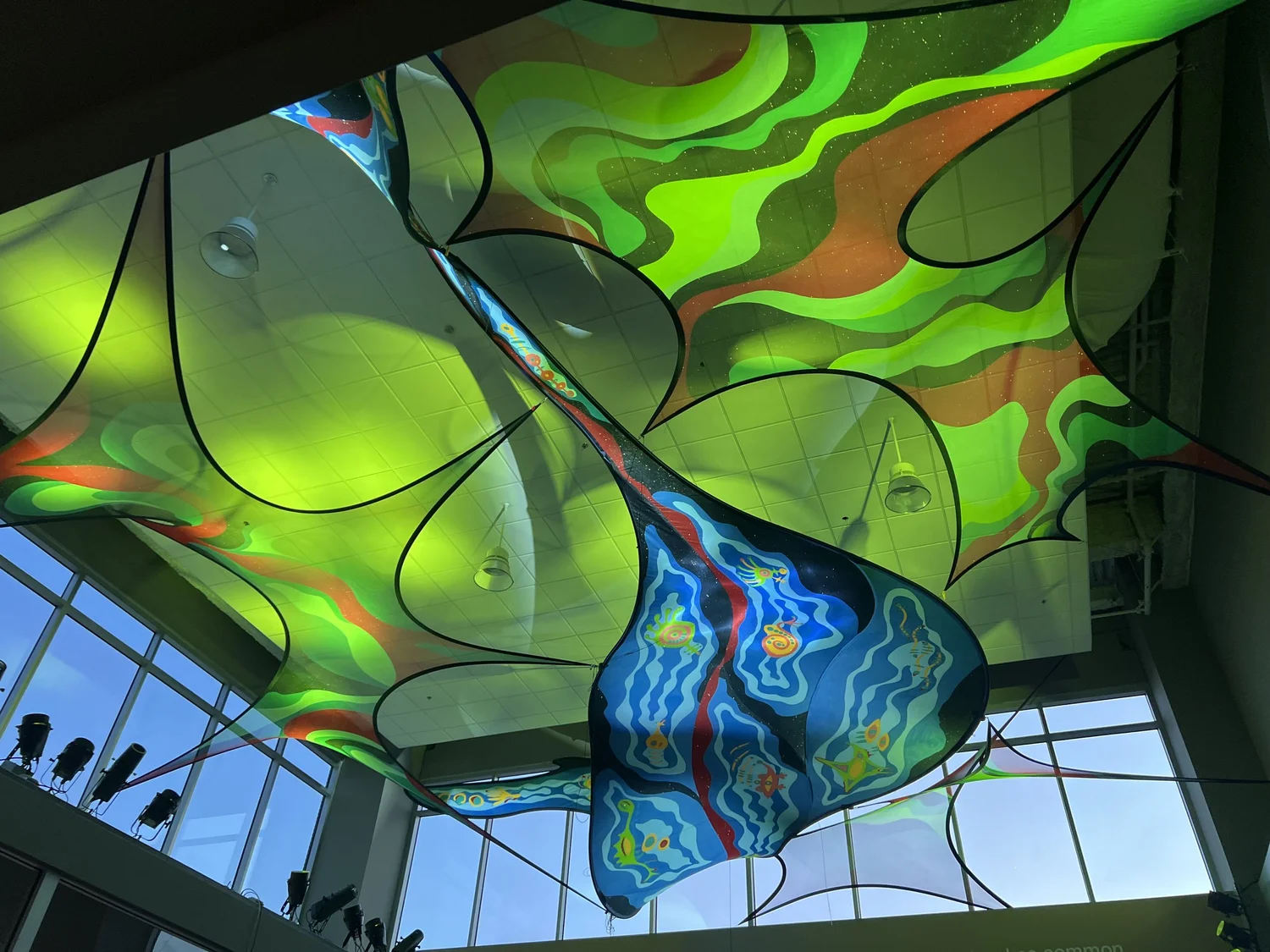
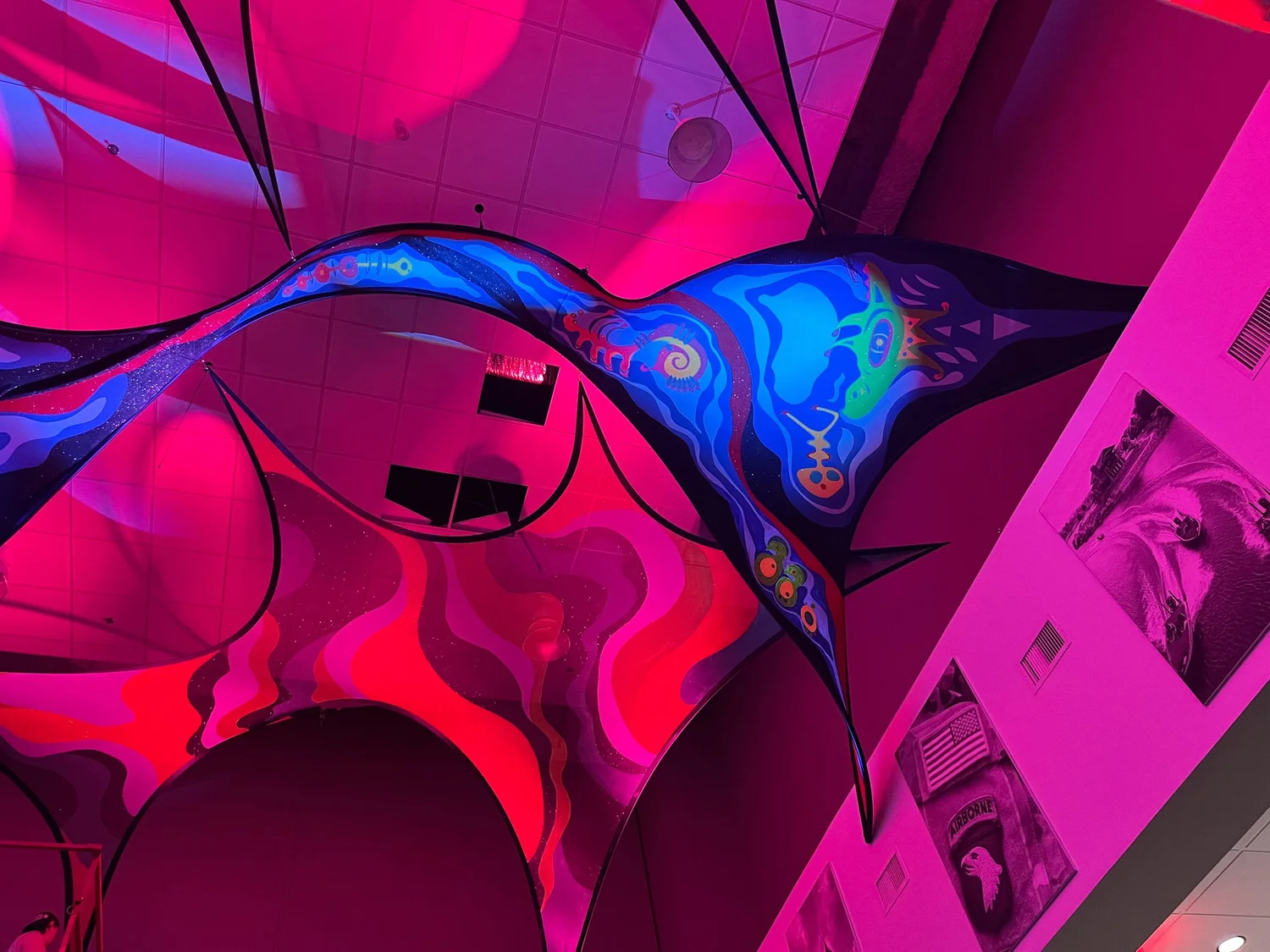
In the F&M Bank Area in downtown Clarksville, you can view a large, multimedia artwork–a tribute to the river by Cynthia Thompson called Always the River. The hand-painted tension fabric sculpture is unlike any other piece of public art in Clarskville-Montgomery County, both in its digital design, scale, and viewings from multiple vantage points in the downtown area. You can see this piece from outside the F&M Bank Arena, especially at night when the lights show through the windows of the building. Patrons dining on the balcony of Strawberry Alley Ale Works on Franklin Street can see the sculpture, Always the River, and the Cumberland River at the same time. There are other locations within this downtown area that have similar views of both the artwork and the river itself. The alignment of the sculpture in the building is not very far from the confluence of the Cumberland and Red Rivers, both of which have shaped Clarksville in dramatic ways.
Thompson writes on her website: “In making this sculpture, I was inspired by the Cumberland River, the Red River and Dunbar Cave. The rivers are the lifeblood of the local civilization, transporting people and distributing food, products and culture. The cave, with its Native American pictographs and petroglyphs dating back to the first human inhabitants of the region, ties us to our long shared history.”
Watch the documentary by Demetrius Hnarakis here:
Cynthia Thompson is the owner of Transformit, an arts company, that has created largescale fabric sculptures in many locations across the country, such as This Little Light of Mine at the Mississippi Civil Rights Museum in Jackson, MS. Transformit and Thompson have designed artworks both temporary and permanent for outdoor events and locations such as parks, greenways, city centers, as well as indoor locations such as museums, event centers, schools, retail shops, hotels, and more.
Transformit and Thompson practice sustainability and environmental stewardship: “At Transformit, we recycle all of our aluminum. Many of the fabrics we use have recycled content. We recycle most of our office waste. Blended fabrics are difficult to recycle, as are printed fabrics, but recycling technology is improving all the time. We recycle those fabrics which can be recycled.”
Thompson and Frank Lott, Executive Director of the Customs House Museum & Cultural Center, met at the Southeastern Museums Conference a few years ago, and Lott advocated for this piece of public art in Clarksville. Thompson writes: “Frank Lott, Executive Director of the Customs House Museum and Cultural Center, Clarksville, TN, brought me into the project and advocated for me and the integrity of the project.”
Always the River is an artwork that your entire family can enjoy. It changes and moves with light and river habitat imagery, just as the rivers change and move, reflecting the light and nature around them, including our own faces on the surface as we look at them.
Sources: Cynthia Thompson Art
Transformit Sustainability Statement
Montgomery County Archives Post
This article is part of a series on Public Art in Clarksville. Check out the articles below to read more in this series:
Patriots Park & the WWI Doughboy: Public Art in North Clarksville – Customs House Museum & Cultural Center Reverence Represented in Public Art – Customs House Museum & Cultural Center
ART + DESIGN with the Public in Mind – Customs House Museum & Cultural Center
Importance of Preserving Clarksville/Montgomery County’s Public Art
Two Trails to Explore for Connected History – Customs House Museum & Cultural Center
Public Art in Clarksville: 4 Outstanding Statues
Public Art in Clarksville: 4 Amazing Murals
Shana Thornton is the Marketing & Media Manager and Managing Editor of Second & Commerce, the Customs House Museum & Cultural Center’s arts, history, and culture magazine. She is an author and publisher, Founder of the Clarksville-Montgomery County African American Legacy Trail, and the Montgomery County Deputy Historian.