By Shana Thornton
The “Tip of the Spear” is a well-known military phrase that references soldiers breaking through enemy lines and refers to the first group or soldier to do so in combat. The phrase symbolizes a courageous beginning and the sharp point that pierces through despite the dangers and challenges. You might define a patriot similarly, especially one who has served in combat. Located at 3176 Fort Campbell Boulevard, Patriots Park is a prominent place in the median of Fort Campbell Boulevard that was created to honor patriots and service members.
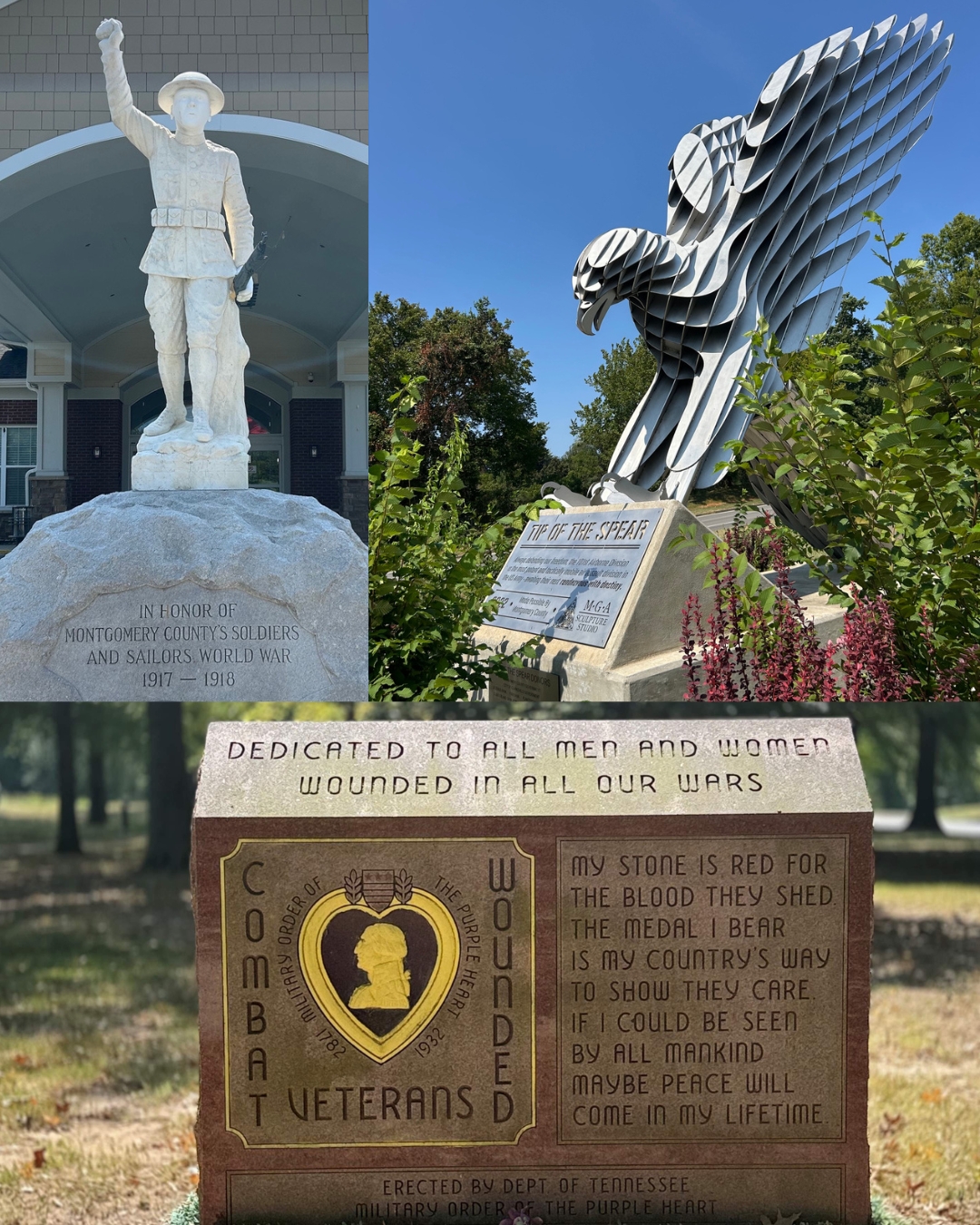
The “Doughboy” was a common WWI term used to describe American enlisted soldiers. But why doughboy and where did the term originate? According to the National WWI Museum and Memorial, several other names were used to describe U.S. soldiers who served in General John Pershings American Expeditionary Forces: “’Yanks,’ ‘Sammies,’ ‘Pershing’s Crusaders’ – these were just some of the names used to label America’s enlisted men in World War I.” The Doughboy term’s source is debated; however, most experts give credit to the Mexican American War as the source of the name. As the WWI Museum & Memorial shares: “Reconciliation with Mexico had just concluded in 1916 when marching foot soldiers in Pershing’s Expeditionary Force traveled south of the border to fight rebel Pancho Villa. Covered in white adobe dust, the foot soldiers were called ‘adobes’ or ‘dobies’ by mounted troops. Within a few months, these dobies, or Doughboys, were redeployed to Europe.”
Patriots Park
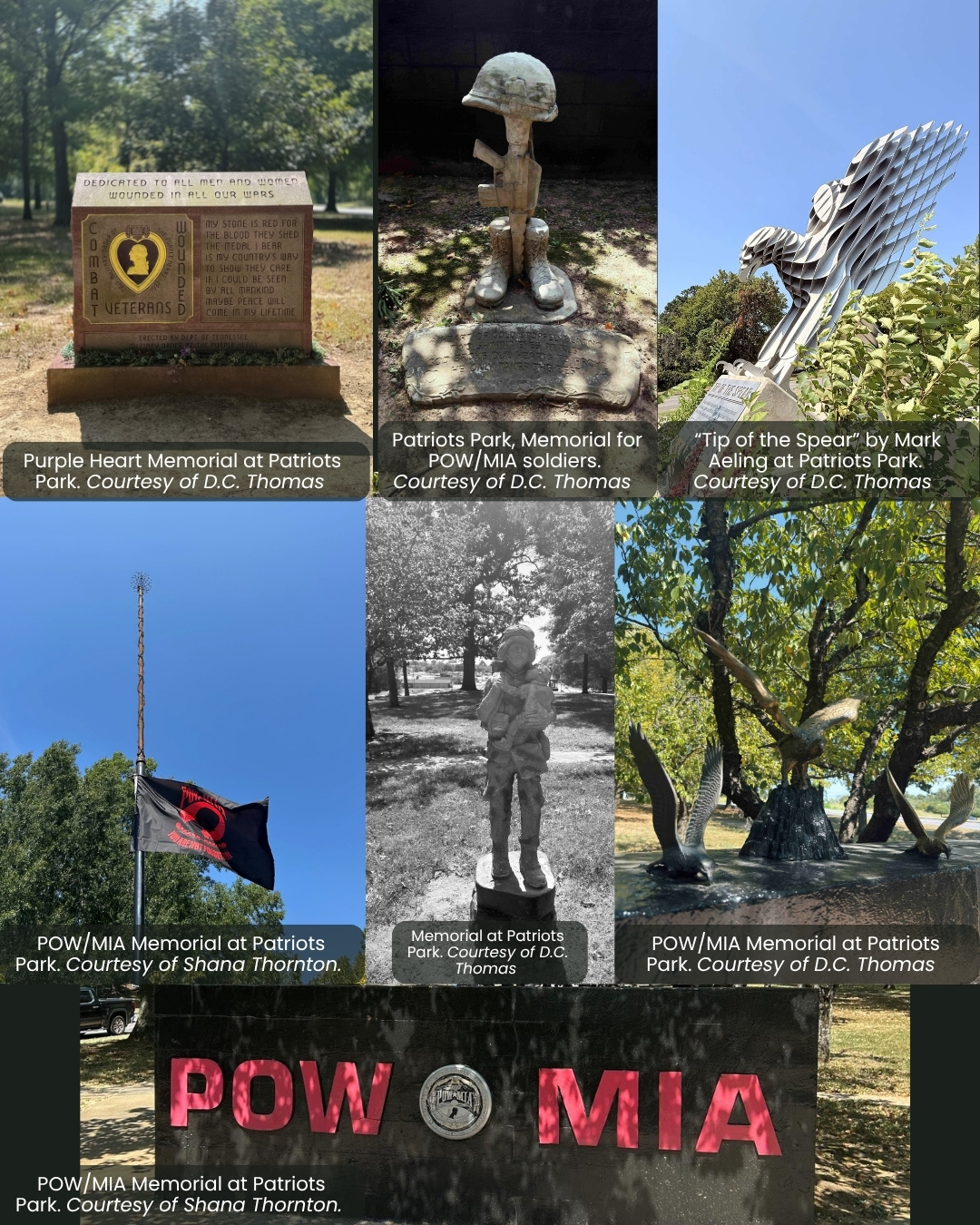
Managed by the City of Clarksville’s Parks and Recreation, this 3.5-acre park includes a short walking path, about a quarter of a mile long with reflection benches along the way. The mature trees offer plenty of shade on the benches and help shelter visitors to the park. There’s also a Purple Heart Monument for Combat Wounded Veterans, a Prisoner of War/Missing in Action (POW/MIA) Monument, and the Tip of the Spear statue. Parking is in front of the Bethel Methodist Church.
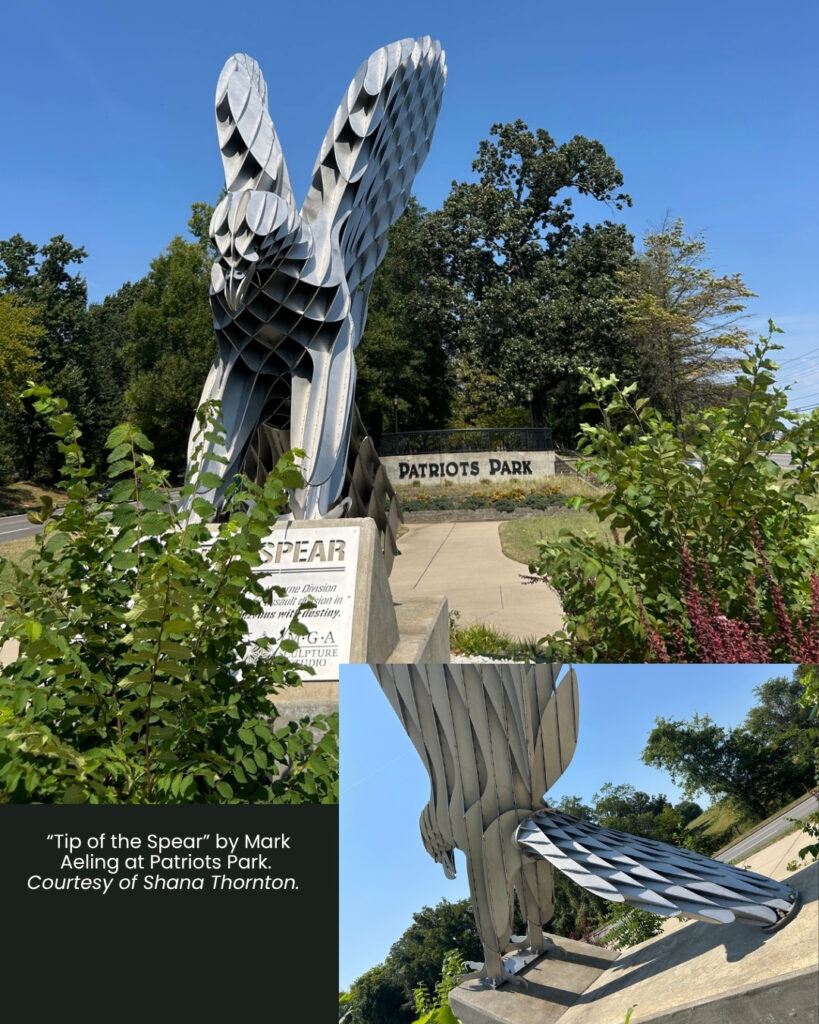
At the tip of park, the Tip of the Spear sculpture, created by artist Mark Aeling and his team in Clearwater, Florida, symbolizes the strength and resilience of the 101st Airborne Division at Fort Campbell. Visit Clarksville notes that, “Including its base, the Tip of the Spear is 27-foot tall and made of 10,000 pounds of surgical-grade stainless steel.” In the sunlight, the stainless-steel shines and illuminates the eagle, making it seem as if it glows in the light. Even at night, the eagle is a striking presence as you travel along Fort Campbell Boulevard.
World War I Doughboy Sculpture
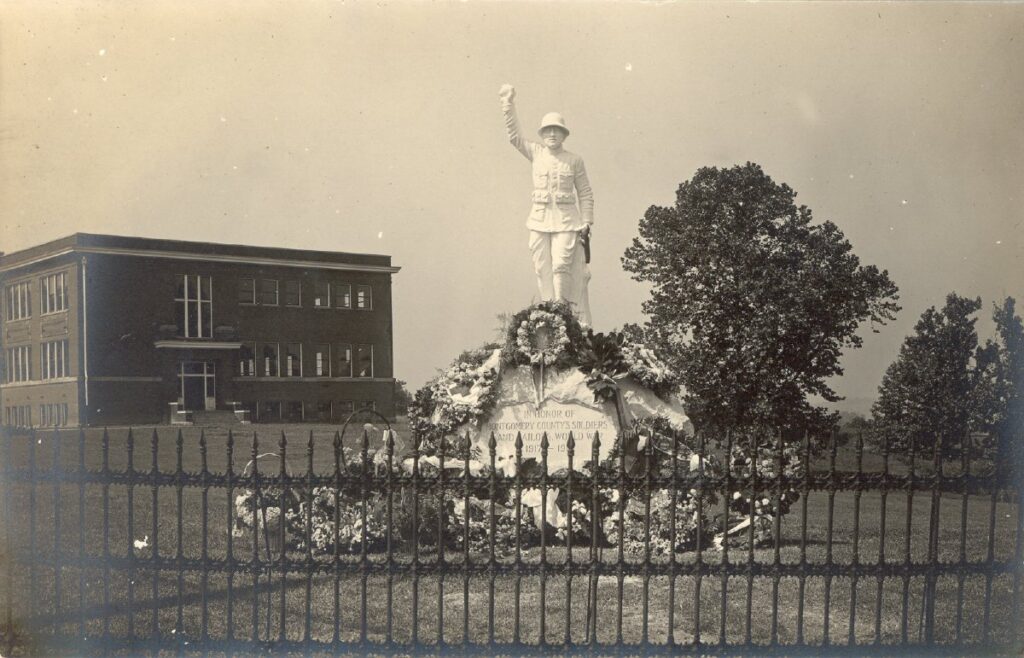
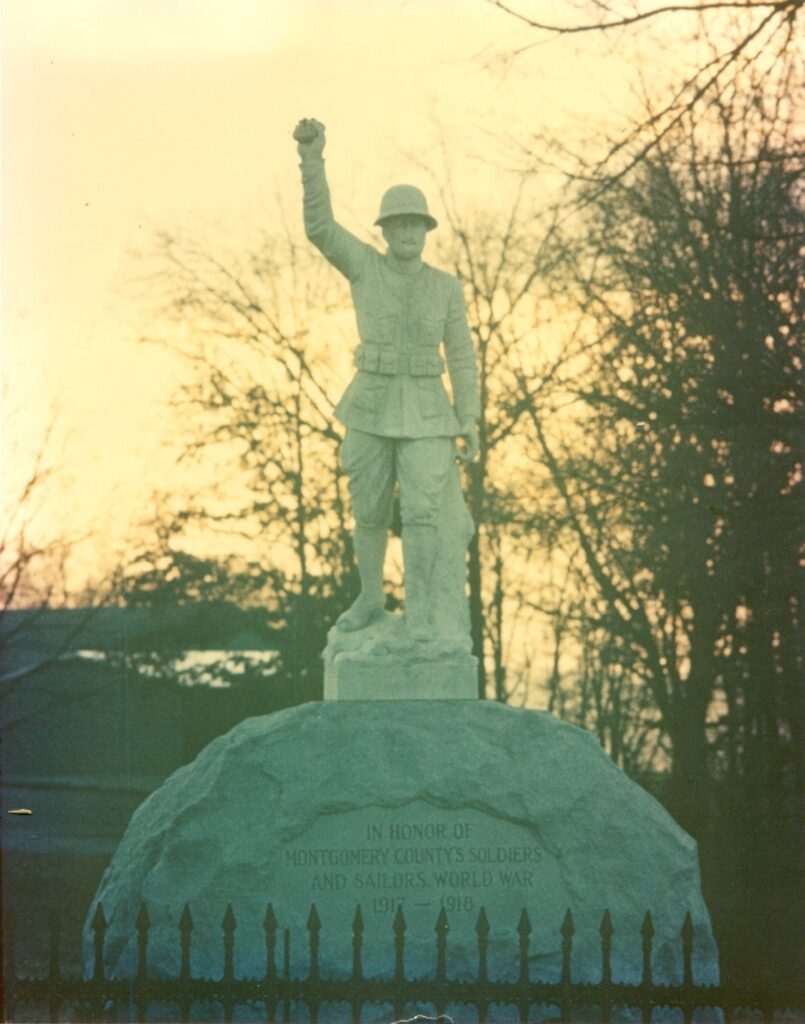
The image above is from a postcard in the Customs House Museum’s Collection, and it was donated by the first official County Historian, Ursula Beach. The postcard depicts the WWI Doughboy statue on the day that the statue was dedicated, June 9, 1929. It was erected as a World War I Memorial at the corner of Greenwood Avenue and Madison Street. There is no postmark on the post card. The white stone statue of a WWI doughboy soldier is on large boulder, and his right arm is raised and contains a grenade. His left arm by his side holds a rifle. Flower arrangements cover the base and sides of the boulder base. A flower wreath is placed at the base of the soldier’s feet. The old Clarksville High School is in background. The inscription on the boulder reads “In Honor of Montgomery County’s Soldiers and Sailors, World War 1917-1919”. According to Mrs. Beach, “During World War II, the rifle was removed for scrap metal.”
The Doughboy stood at the corner of Madison and Greenwood for 42 years. The Doughboy was moved to the National Guard Armory on Fort Campbell Boulevard in 1972, then in 2010, it was moved to the Clarksville Transit Station on Legion Street, after being renovated by sculptor Scott Wise. The rededication ceremony brought quite a crowd to Clarksville, including family members of one of Tennessee’s most famous WWI veterans, Sergeant Alvin C. York. Photo below was taken between 1960-70, by Dr. Carlos Brewer, and donated to the Customs House Museum’s Collection. You can see that the rifle is missing from his left arm.
Finally, the Doughboy was moved again in 2015, to its current home, General Wendall H. Gilbert’s Tennessee State Veterans Home, located at 250 Arrowood Drive, and his rifle has been replaced.
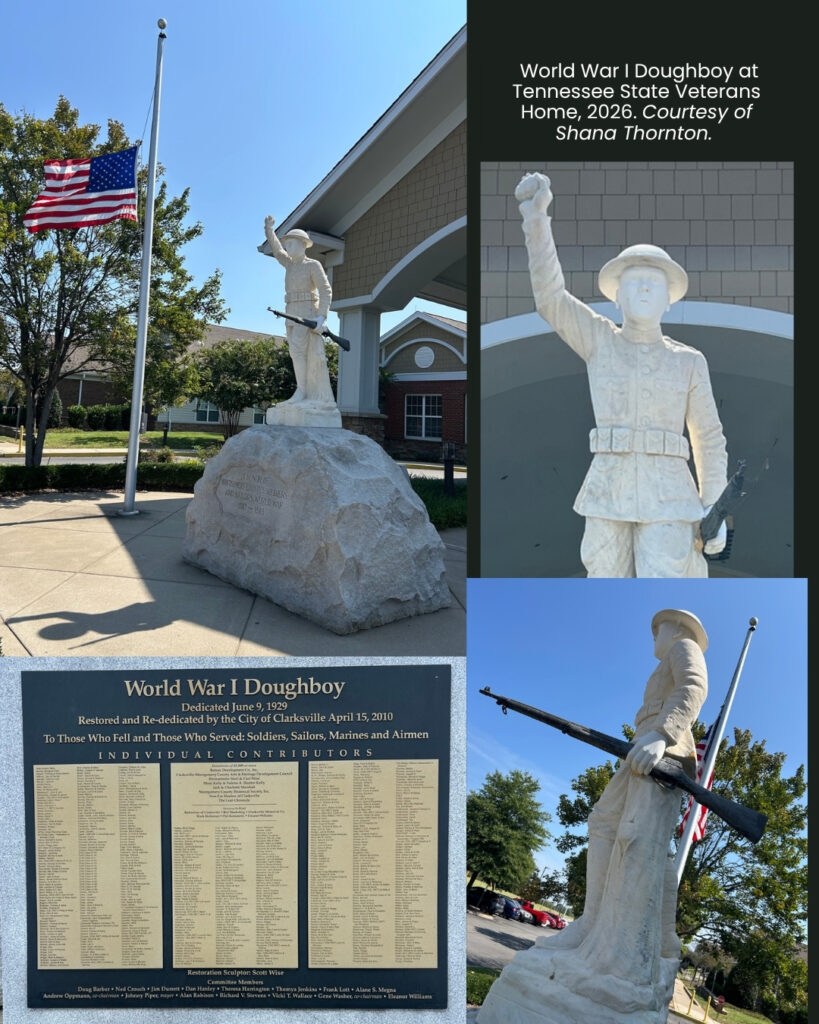
Visit these locations in North Clarksville, near Fort Campbell Army Post, to see some of Clarksville-Montgomery County’s patriotic public art.
Sources: WWI Museum and Memorial Website
This article is part of a series on Public Art in Clarksville. Check out the articles below to read more in this series: Reverence Represented in Public Art – Customs House Museum & Cultural Center
ART + DESIGN with the Public in Mind – Customs House Museum & Cultural Center
Importance of Preserving Clarksville/Montgomery County’s Public Art
Two Trails to Explore for Connected History – Customs House Museum & Cultural Center
Public Art in Clarksville: 4 Outstanding Statues
Public Art in Clarksville: 4 Amazing Murals

Shana Thornton is the Marketing & Media Manager and Managing Editor of Second & Commerce, the Customs House Museum & Cultural Center’s arts, history, and culture magazine. She is an author and publisher, Founder of the Clarksville-Montgomery County African American Legacy Trail, and the Montgomery County Deputy Historian.